Weekly Report - July.18, 2026
Why the market is mispricing a massive 16,900+ boe/d cash cow—and giving you an upcoming multi-decade industrial utility business completely for free

It was another lackluster week for many commodity-related stocks. These sectors continue to sharply underperform the general market and the crowds are currently chasing overextended tech multiples.
But let’s be honest: this is nothing new to veteran commodity investors.
As frustrating as it may be to watch from the sidelines, this cyclical drift presents a phenomenal, asymmetric opportunity for the patient investor. This exact phase of market capitulation is where the seeds get planted for the next big moves. While the undisciplined panic, we get the rare chance to step in and buy some of the highest-quality, world-class names in the natural resource space at massive, double-digit discounts.
To highlight a perfect example of this disconnect, I sent out a note mid-week highlighting the uranium sector as being heavily beaten down and very cheap once again. Many of the core names I follow and hold are getting incredibly close to their 2020 levels.
The valuation gap here is just staggering. In 2020, equities were trading at these exact prices while uranium spot was struggling in the low $30s/lb. Today, physical uranium spot sits firmly in the mid-$80s and long-term utility contract prices are holding strong at $94/lb. Yet, the shares are being priced like the macro thesis is dead.
This extreme divergence between the underlying commodity price and the capital entering the equity space is an opportunity. It is a thesis I continue to thoroughly believe in, and I absolutely love the opportunity to aggressively add to my highest-conviction positions at these prices.
Thoughts from the week
Supply Chains and Persistent Inflation
Supply chain issues are quietly arising again, and historically, this correlates directly into consumer prices ticking higher with a lag. Inflation remains incredibly sticky and persistent.
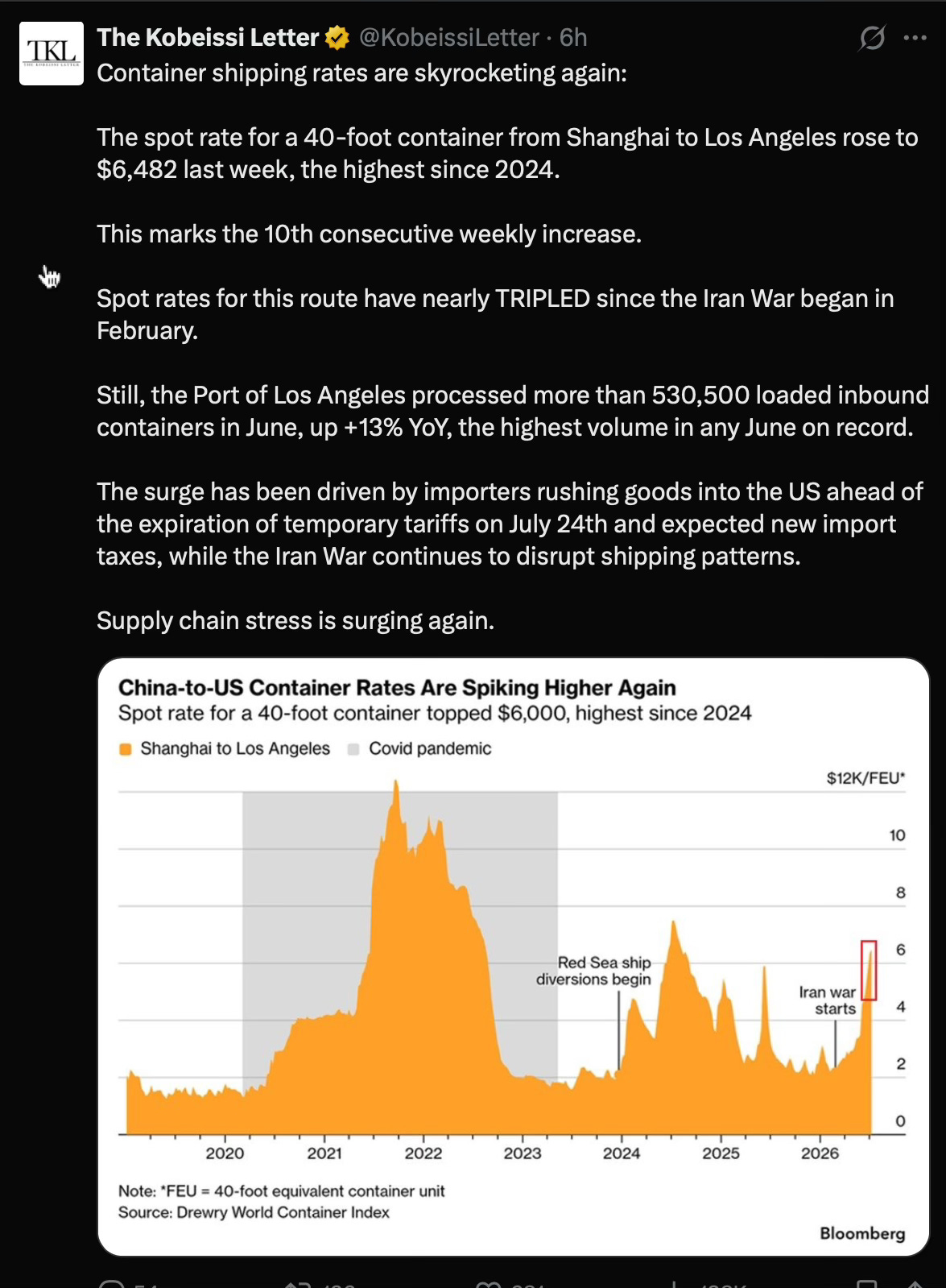
Look no further than global shipping data to see the trend shifting back. Container shipping rates are skyrocketing once again, with spot rates for a 40-foot container from Shanghai to Los Angeles topping $6,400 last week—marking a staggering 10 consecutive weekly increases. Driven by ongoing geopolitical disruptions in the Middle East and importers rushing goods ahead of impending tariff deadlines, shipping costs on major routes have nearly tripled over the last few months.
This supply chain stress acts as a direct, structural tailwind for tangible hard assets. While the broader stock market is pricing in a clean return to low inflation and aggressive central bank rate cuts, the physical reality on the ground paints a completely different picture. Higher input costs and logistics friction mean the cost of doing business is rising, proving that inflation is structurally embedded.
Cracking Oil Profits
To understand why structural inflation isn’t going away, look no further than what is happening in the energy sector. Wall Street algorithms keep selling down energy and mining equities on the assumption that the macro cycle is rolling over, but the physical data paints a completely different picture.
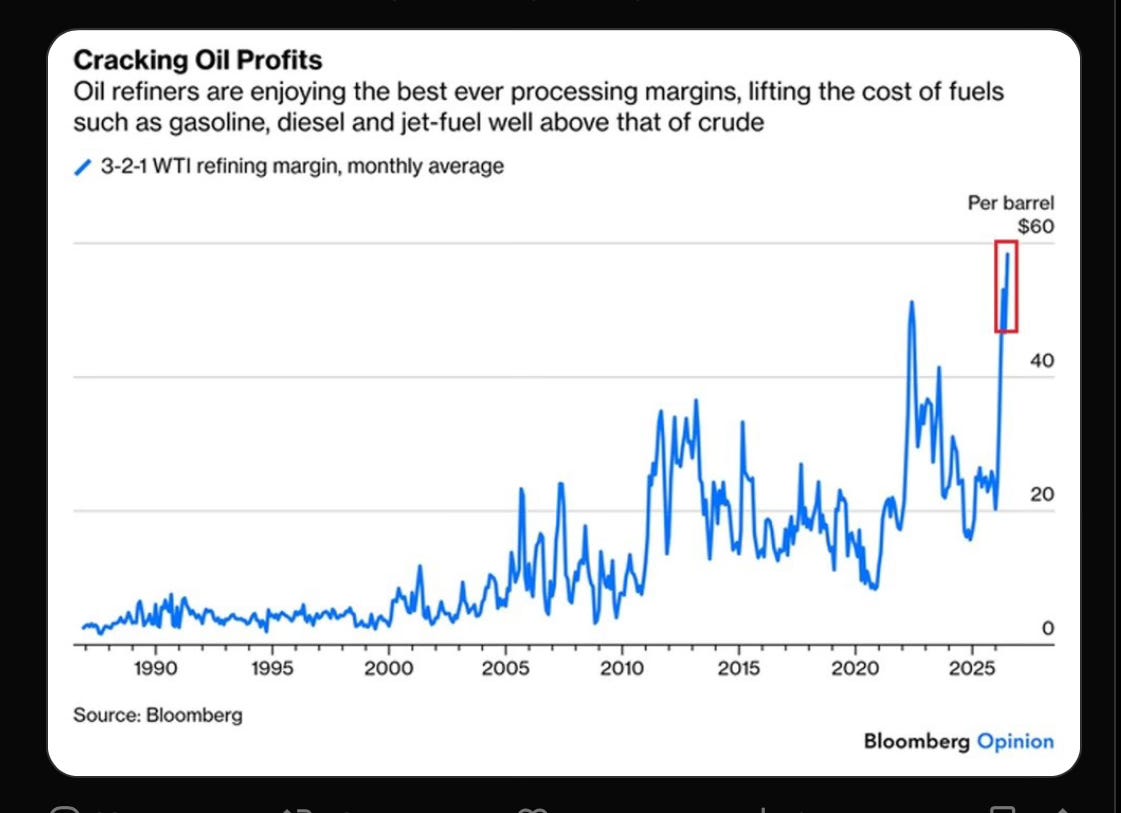
Take a look at the 3-2-1 WTI Refining Margin (the “crack spread”), which measures the profit margin of turning three barrels of crude oil into two barrels of gasoline and one barrel of diesel. Historically, this margin averaged around $10 to $15 per barrel. Today, it has rocketed to an unprecedented, historic high of nearly $60 per barrel.
It tells us that raw crude supply isn’t the primary bottleneck; the physical infrastructure to refine it is completely choked. With global refining capacity severely restricted due to ongoing geopolitical conflicts and disruptions to downstream facilities, the world is structurally short on fuel.
Even if raw crude prices fluctuate, the actual refined products driving global shipping, trucking, and aviation remain pinned to the ceiling. Refiners are printing record amounts of cash because the physical market is incredibly tight.

A Disenfranchised Generation
While Wall Street looks at inflation as a mere data point on a spreadsheet, the social reality on the ground is stark. A recent headline highlighted a staggering metric from The New York Times: 1 in 3 adults under the age of 35 is now living with their parents.
Think about how disenfranchised this makes an entire younger generation. They are completely squeezed out of the foundational economic opportunities—like affordable housing and capital formation—that previous generations took for granted. When the cost of shelter, fuel, and daily living outpaces real wage growth year after year, the structural “social contract” breaks down.
From a macro perspective, this is exactly what persistent, structural inflation does: it violently redistributes wealth away from those trying to build a future and hands it to those who already own the hard assets.
History shows us that this level of economic stagnation cannot last forever. At some point, this degree of demographic pressure leads to drastic changes politically, socially, and economically. We are already seeing the initial tremors of this shift as populist movements grow and trust in traditional institutions plummets.
Atlas Salt Update
I highlighted this company in early May when it was trading at $1.17. Shortly after that report, the stock went completely parabolic, rocketing to a recent 52-week peak of $1.83. To close out last week, however, the equity experienced a very sharp, sudden pullback, erasing a large chunk of those rapid gains to close Friday at $1.41.
Technically, this is entirely healthy. Aggressive, multi-week runups almost always trigger sharp profit-taking events, and the stock appears to have found an immediate, solid area of horizontal support at this $1.41 level.
More importantly, there was absolutely no negative corporate news behind the selloff. In fact, Atlas Salt has put out some of its best operational milestones since my initial report:
Active Site Construction Authorized: On July 7, 2026, the company cleared its remaining Environmental Assessment conditions and officially transitioned the Great Atlantic Salt Project out of the planning phase and into active mine construction.
Civil Engineering Mobilization: Earthworks contractors (On Grade Construction) have already mobilized heavy equipment to the site.
Streamlined Development Permitting: Crucially, the Town of St. George’s issued a single, comprehensive Development Permit authorizing the entire scope of early project works. This eliminates the need to apply for dozens of separate granular municipal permits, massively accelerating the infrastructure timeline.
Debt Financing Underway: Advanced talks with prospective institutional lenders and project financing activities are actively moving behind the scenes.
My conviction on this setup remains exceptionally high, and I plan to look for opportunities to add to my position next week. For a project with an updated after-tax NPV of C$920M, trading at a market cap of roughly C$175M, this remains deeply undervalued for its current de-risked stage of development. This is a tier-one asset with a high probability of becoming an operating mine soon, and the equity re-rate when construction funding formally locks in will be substantial.
Spotting the Anomalies: A Technical Breakout
There wasn’t much in the way of Stage 2 breakouts that showed up on my technical screens this week. Amid the broader commodity malaise, almost everything is drifting sideways or getting washed out in the panic. However, there was one major anomaly that put together a phenomenal technical breakout, completely bucking the trend. It is a natural gas and condensate producer in Central Asia that is rapidly expanding, and it appears the market is aggressively rewarding them.